





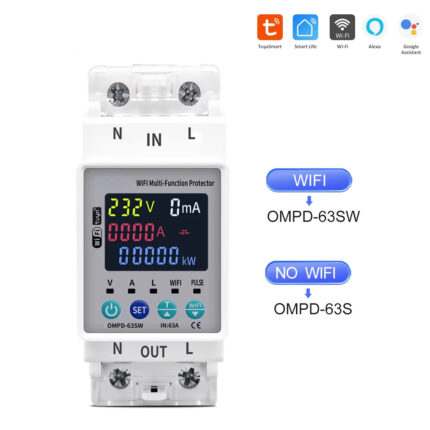
NewTrend · WiFi voltage current and leakage protector
Product overview
The OMPD-63LW is a single-phase WiFi protector with voltage, current, leakage-current and energy monitoring. It disconnects both the L and N conductors. Local controls and Tuya Smart / Smart Life provide remote switching, adjustable protection settings, metering and timing functions.

Protection and smart control
Over-voltage, under-voltage, over-current and leakage-current monitoring are combined with automatic reconnection and remote ON/OFF control. Read voltage, current, leakage current and accumulated kWh on the unit or phone. Use a 2.4 GHz WiFi network; 5 GHz is not supported.

Technical selection summary
| Model / offered version | OMPD-63LW; 63 A version |
|---|---|
| Nominal supply | AC 230 V, 50/60 Hz |
| Input operating range | AC 140–300 V, exact parameter table |
| Switched conductors | Both L and N |
| Current adjustment | 1–63 A; stated default 40 A |
| Over-voltage threshold | 230–300 V; stated default 270 V |
| Over-voltage recovery | 225–295 V; stated default 265 V |
| Under-voltage threshold | 140–210 V; stated default 170 V |
| Under-voltage recovery | 145–215 V; stated default 175 V |
| Current recovery reference | 0.5–62.5 A, 63 A version |
| Leakage-current threshold | 10–99 mA; stated default 30 mA |
| Recovery delays | 1–500 s; stated default 30 s |
| Power-on / display interval delay | 1–500 s; stated default 10 s |
| Protection action time | Web parameter/menu reference: 1–30 s, default 1 s; catalogue reference: 0.1–30 s |
| Repeated over-current / leakage fault limit | 1–20 operations; source default OFF |
| Voltage/current/power calibration | −9.9% to +9.9% |
| Power consumption | Written <2 W; parameter table ≤2 W |
| Electrical/mechanical life | ≥100,000 cycles, parameter table |
| Dimensions | 95 × 45 × 68 mm, exact parameter table and complete catalogue drawing |
Timing and remote operation
Switch remotely, schedule operations or use the timer/loop controls in the Tuya Smart / Smart Life app. The original illustration also shows example linked smart-home services.

Voltage protection and recovery
The exact technical table and programming diagram distinguish the over-voltage trip threshold, 230–300 V, from its recovery threshold, 225–295 V. Their stated defaults are 270 V and 265 V respectively. Under-voltage trip and recovery thresholds are independently adjustable.

Current protection
Set the over-current threshold locally or in the app. The offered 63 A version has a 1–63 A setting range and stated default 40 A. Recovery delay and the repeated-fault count limit can be adjusted.

Prepaid energy function
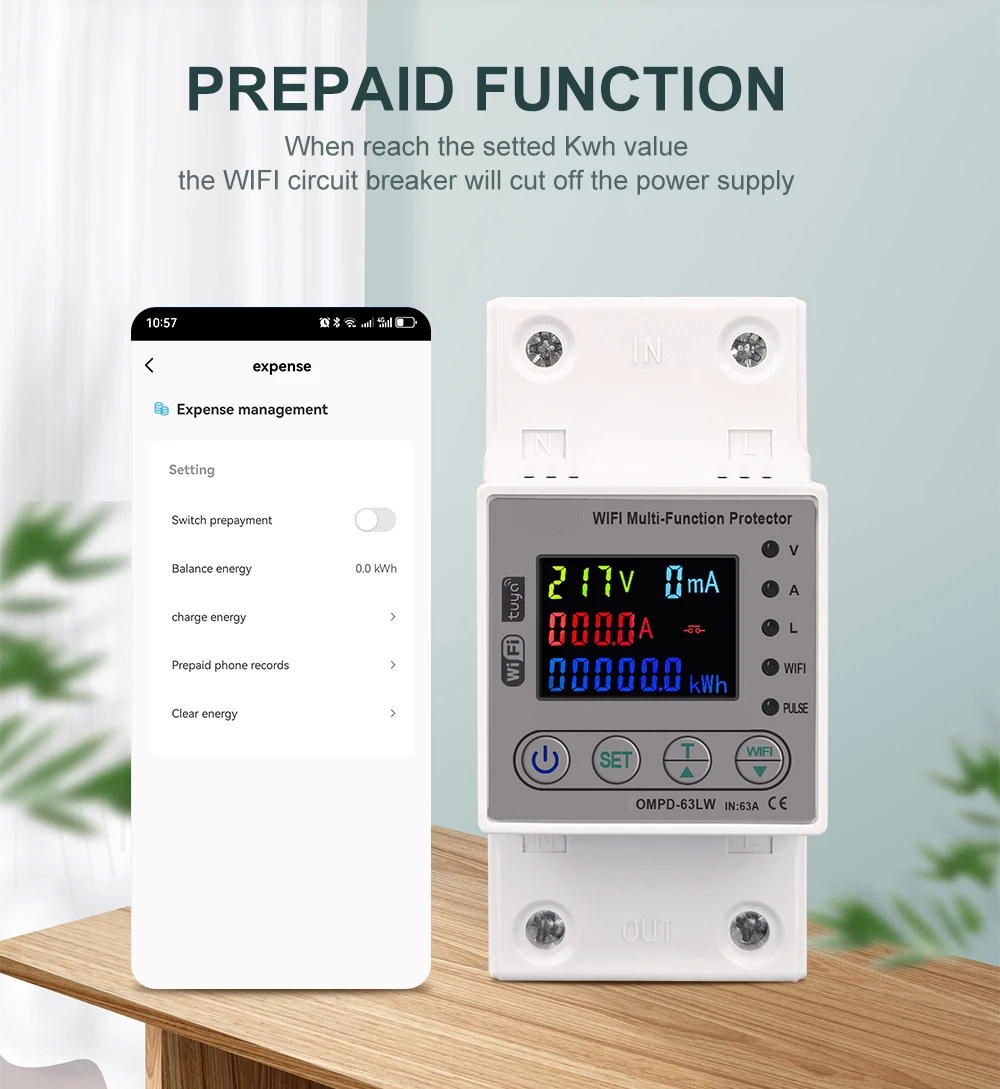
The source describes a prepaid energy allowance: when the allocated kWh is reached, the device switches off the power supply. The app illustration shows the remaining-energy setting.
Leakage-current protection
The 10–99 mA leakage-current threshold, recovery delay and repeated-leakage fault limit are adjustable. A test key is provided on the front panel. The complete technical reference explains automatic recovery and the manual reset required when a continuous fault limit has been reached.

Energy history and remote monitoring
The app provides electrical data and historical electricity statistics for reviewing connected-load operation. The displayed measurements in the original screenshots are examples.

Real-time measurements
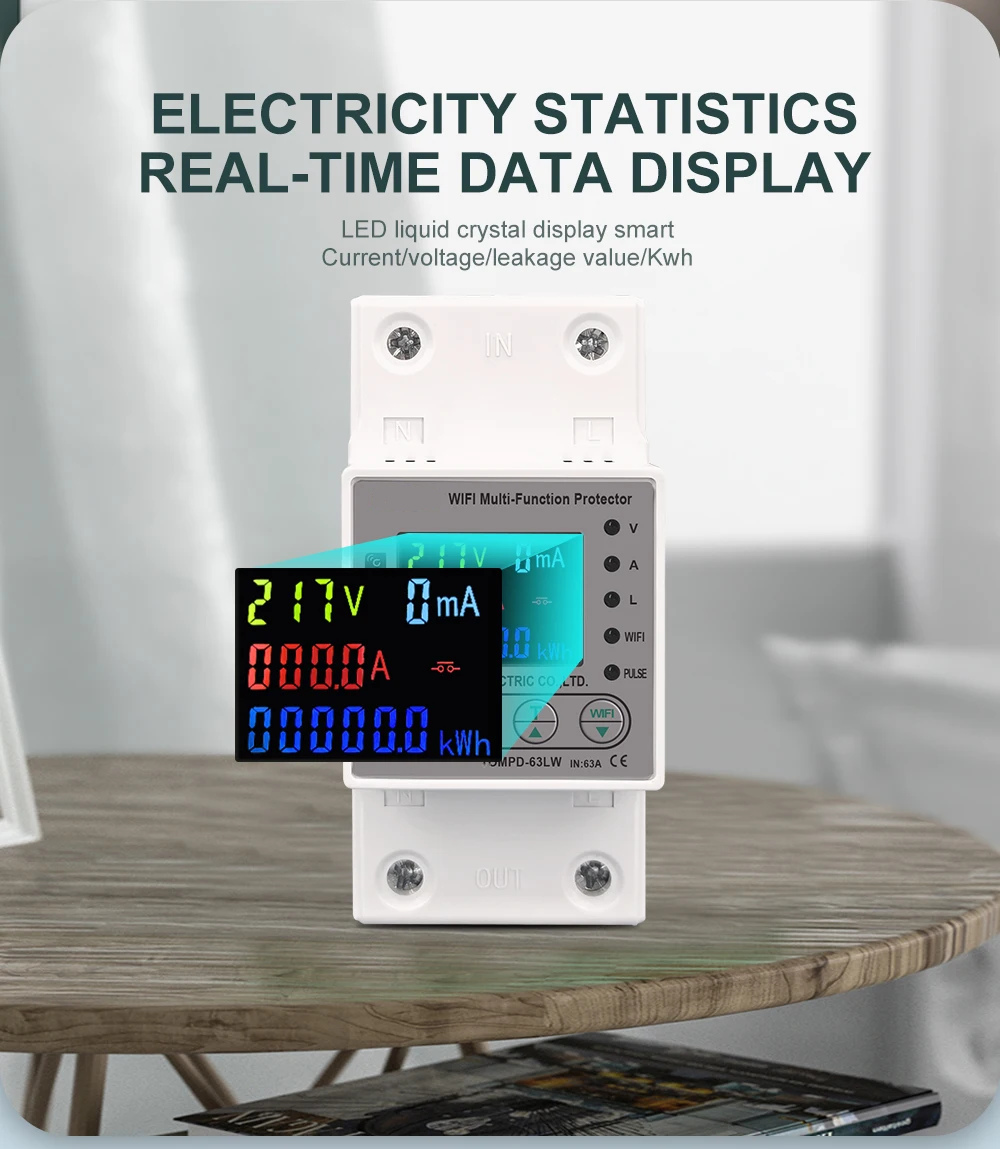
The display shows voltage, leakage current and current, with an energy/power display area. Separate indicators identify voltage, current, leakage, WiFi and energy pulses.
Energy, power and power factor display
The original reference shows kilowatt-hours, active power and power factor displayed in turn. Display interval is set in the local menu.

L and N switching structure
The original internal reference illustrates the device structure and states that both the neutral and live conductors can be disconnected.

Local programming: display and voltage
The original menu covers display brightness, display interval, power-on delay, over-voltage trip/recovery/delays and under-voltage trip/recovery/delays. The exact values and code labels are preserved below.

Local programming: current, leakage and calibration
The continuation covers current trip/recovery, repeated current faults, leakage threshold/recovery, repeated leakage faults, calibration, saving and manual switching. The 80 A family reference in the menu is retained; this page offers the 63 A version.

App configuration
The app screenshots show soft reset, threshold/alarm settings and a schedule screen for remote operation.

Wiring
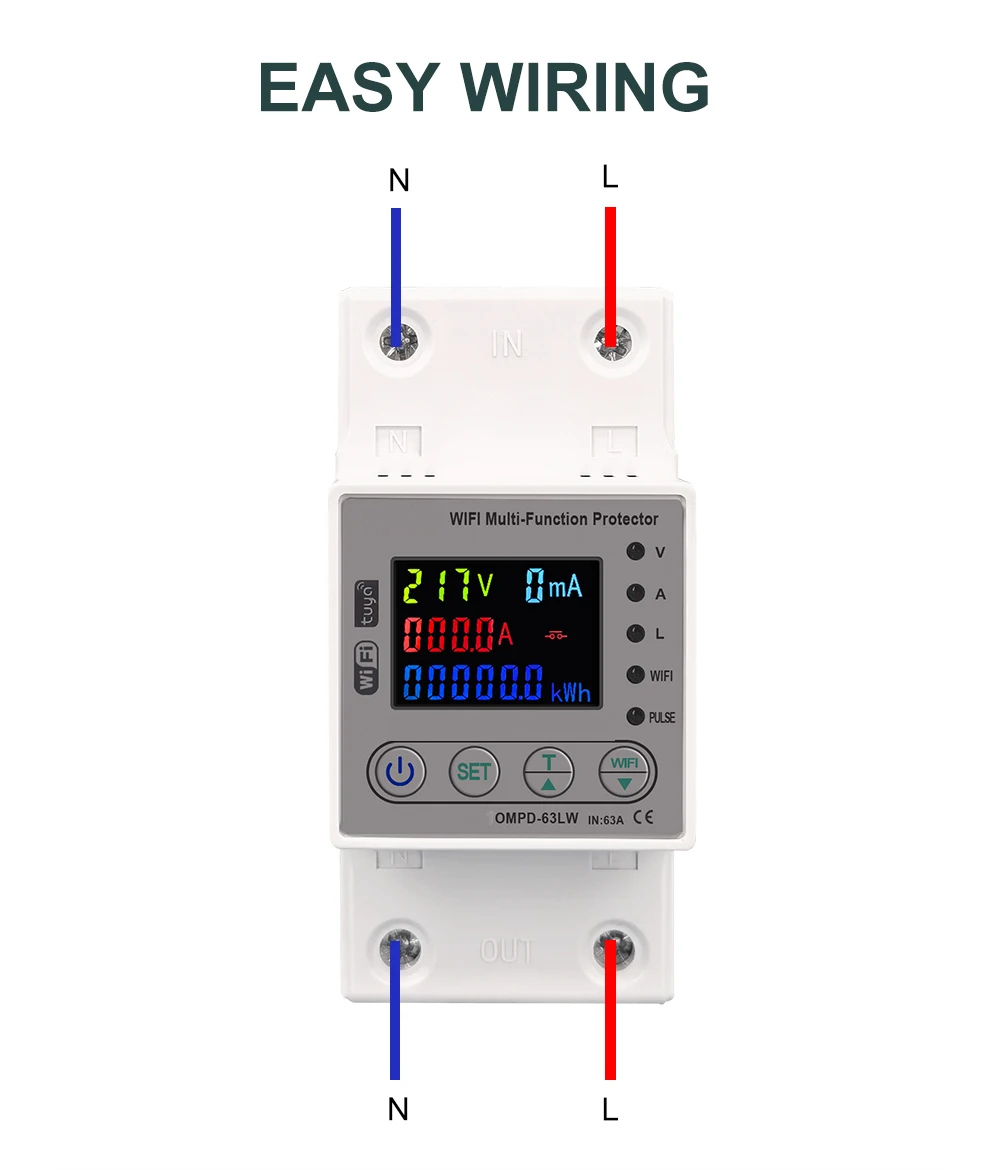
Connect the supply L and N at the top and the load at the bottom, according to the unit markings. Both conductors are switched by this version.
Panel indicators and keys
The original annotated panel identifies protection and WiFi indicators, the kWh pulse indicator, manual ON/OFF, SET, adjustment, leakage-test and WiFi controls. The catalogue specifies holding SET for 3 seconds to enter settings, T for 3 seconds to test leakage, and the WiFi key for 5 seconds to configure WiFi.

Original technical parameter table
The exact parameter reference includes both 63 A and 80 A family data. For the 80 A reference it states 1–80 A current setting, default 60 A, and 0.5–79.5 A recovery. Those family values are not the offered 63 A configuration.

Dimensions and complete technical reference
The web dimension illustration gives 95 mm height and 45 mm width. The complete two-page PDF retains the original operating table, complete programming menu, panel diagram, wiring, full 95 × 45 × 68 mm dimension drawing and protection-state explanations.