



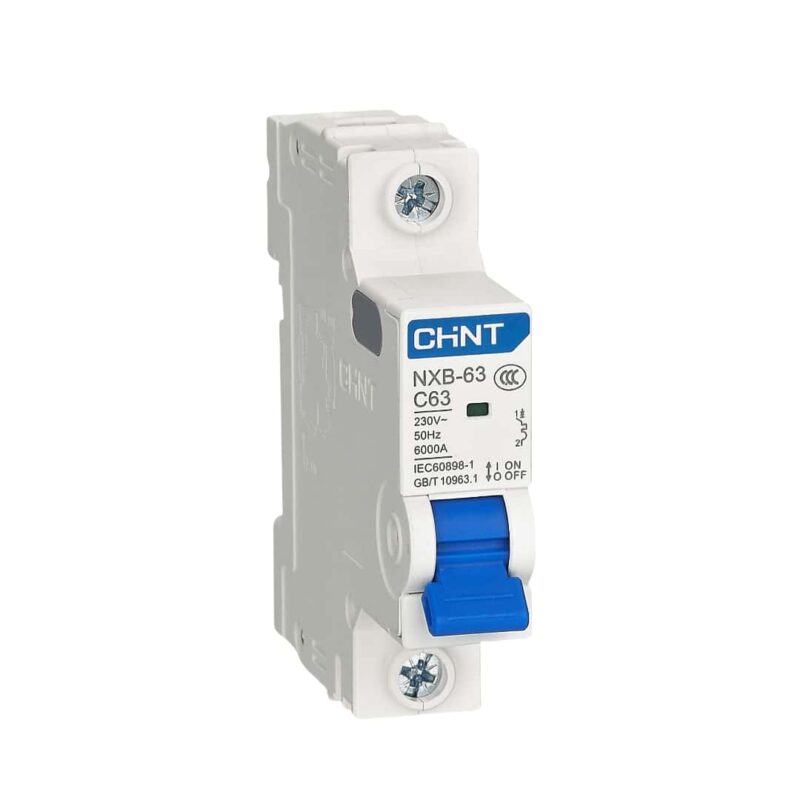

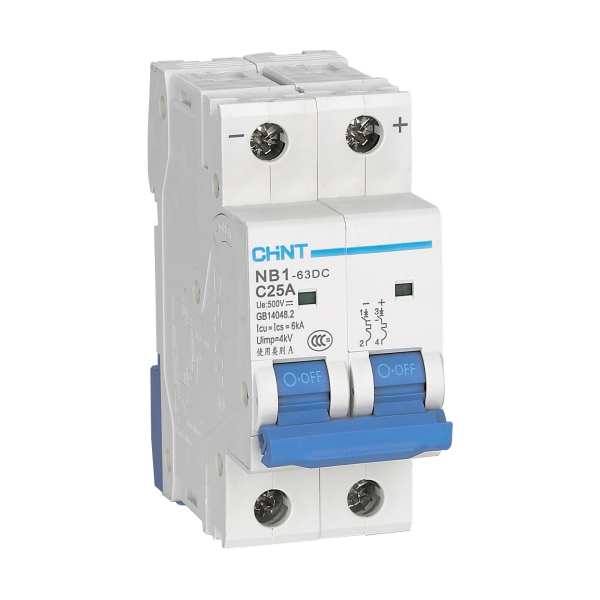
Selecting the correct DC Miniature Circuit Breaker (MCB) for your solar PV combiner box directly impacts system safety, longevity, and compliance. This technical guide walks through the critical selection criteria that separate adequate protection from optimal performance.
Why DC MCB Selection Matters in Solar Applications
Solar PV systems present unique challenges:
- High DC voltages: 1000V-1500V DC requires specialized arc suppression
- Continuous operation: 25-year system life demands proven durability
- Outdoor exposure: UV, temperature cycling, and humidity resistance
- Safety critical: Fault protection prevents fire and equipment damage
Incorrect breaker selection risks nuisance tripping, insufficient protection, or catastrophic failure.
Step 1: Determine System Voltage Rating
Common Solar System Voltages
| System Type | String Voltage | Required MCB Rating |
|---|---|---|
| Residential | 400-600V DC | 600V DC minimum |
| Commercial | 600-1000V DC | 1000V DC standard |
| Utility-Scale | 1000-1500V DC | 1500V DC required |
Critical Rule: Your DC MCB voltage rating must equal or exceed maximum system open-circuit voltage (Voc) at lowest expected temperature.
Temperature Correction Example:
- Panel Voc at STC: 45V × 20 panels = 900V
- Temperature coefficient: -0.3%/°C
- Lowest temperature: -10°C (25°C below STC)
- Corrected Voc: 900V × 1.075 = 968V
- Required MCB rating: 1000V DC minimum
Step 2: Calculate Correct Current Rating
Sizing Formula
` Breaker Rating = 1.25 × 1.25 × Isc = 1.56 × Short Circuit Current `
Why 1.56x?
- 1.25: Safety factor for continuous operation (NEC 690.8)
- 1.25: Additional margin for irradiance variations
Practical Example
| Panel Specification | Calculation | Result |
|---|---|---|
| Isc per panel | 9.5A | – |
| Strings per breaker | 2 | – |
| Total Isc | 9.5A × 2 | 19A |
| Required breaker | 19A × 1.56 | 29.6A |
| Standard size | Round up | 32A |
Step 3: Select Appropriate Trip Characteristic
DC MCB Curve Types for Solar
| Curve Type | Trip Range | Solar Application |
|---|---|---|
| B Curve | 3-5×In | String protection with low inrush |
| C Curve | 5-10×In | Most common for solar |
| D Curve | 10-20×In | High inrush or inverter protection |
Recommendation: C-curve MCBs suit 95% of solar PV combiner box applications, handling capacitor inrush while providing reliable short-circuit protection.
Step 4: Evaluate Breaking Capacity
Understanding Icu (Ultimate Breaking Capacity)
Your DC MCB must safely interrupt maximum prospective fault current:
| System Size | Typical Isc | Minimum Icu Required |
|---|---|---|
| Residential (<10kW) | 1-3kA | 6kA sufficient |
| Commercial (10-100kW) | 3-10kA | 10kA recommended |
| Utility (>100kW) | 10-20kA | 20kA required |
Installation Tip: Always verify DC breaking capacity—not all AC-rated breakers safely interrupt DC arcs.
Step 5: Consider Environmental Ratings
Critical Specifications for Outdoor Installation
| Environmental Factor | Requirement | Test Standard |
|---|---|---|
| Temperature Range | -40°C to +70°C | IEC 60947-2 |
| Humidity | 95% RH non-condensing | IEC 60068-30 |
| UV Resistance | Required for outdoor | UL 489B |
| Pollution Degree | PD3 (outdoor conductive dust) | IEC 60664-1 |
| IP Rating | IP20 minimum, IP65 preferred | IEC 60529 |
Step 6: Verify Certification Requirements
Essential Certifications by Market
| Market | Required Certification | Standard |
|---|---|---|
| United States | UL 489 or UL 489B | UL Listed |
| Europe | CE Marking | IEC/EN 60947-2 |
| Australia | RCM | AS/NZS IEC 60947-2 |
| Global | CB Scheme | IEC 60947-2 |
Beware: “CE self-certified” products may lack genuine safety testing. Demand third-party test reports.
Common Selection Mistakes to Avoid
❌ Mistake 1: Using AC MCBs for DC Circuits
Reality: AC breakers rely on current zero-crossing to extinguish arcs. DC arcs persist, requiring specialized arc chutes and contact designs.
❌ Mistake 2: Ignoring Temperature Derating
Reality: Breaker capacity decreases at high ambient temperatures. A 32A breaker may only handle 25A at 60°C enclosure temperature.
❌ Mistake 3: Bi-Directional Current Oversight
Reality: Solar systems experience reverse current during faults. Ensure your DC MCB is rated for bi-directional breaking.
❌ Mistake 4: Voltage Rating Margin Too Tight
Reality: Cold-weather Voc can exceed nominal by 15-20%. Always apply temperature correction factors.
Recommended DC MCB Specifications Summary
For a typical commercial 100kW solar installation:
| Parameter | Specification |
|---|---|
| Voltage Rating | 1000V DC (or 1500V DC for 1500V systems) |
| Current Rating | 32A-63A (based on string calculation) |
| Trip Curve | C-Curve |
| Breaking Capacity | 10kA minimum |
| Temperature Range | -40°C to +70°C |
| Certifications | UL 489B, IEC 60947-2 |
| Enclosure Rating | IP65 for outdoor installation |
Related products on our website
If you want to compare similar options or move from article reading to product review, start with these links:
Conclusion
Proper DC MCB selection requires systematic evaluation of voltage, current, environment, and certification requirements. The investment in correct specification prevents costly failures and ensures 25-year system reliability.
Need application-specific guidance? Our solar application engineers provide complimentary breaker sizing calculations and compliance verification.